Tuesday 101: The American Connections
Funny story, having taken a blog break, I decided to abandon the arbitrary numbering system I’d been using on my posts and just keep a regular count. It turns out this is #101, at least on Substack.
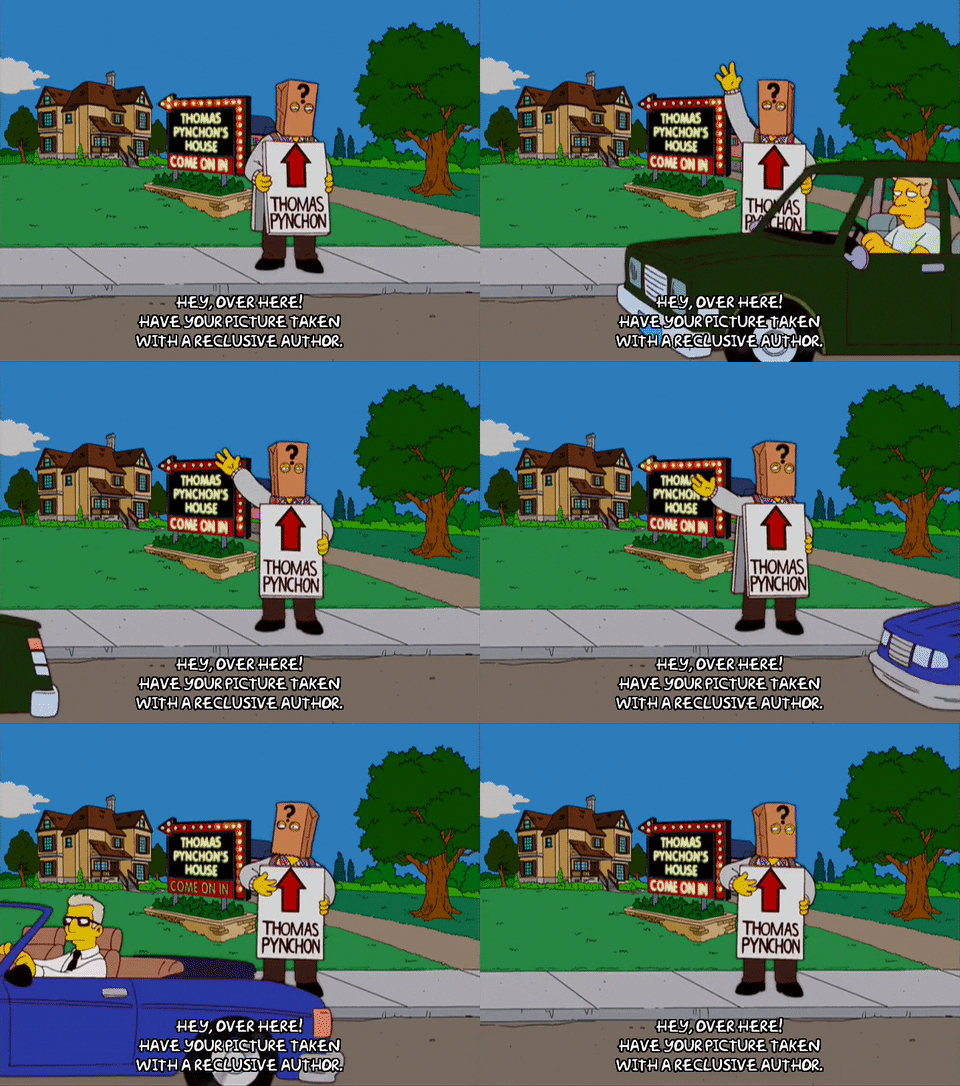
In an interview following the release of the film Inherent Vice, director Paul Thomas Anderson says one of the questions that enticed and followed him throughout the production was why, in 2009, Thomas Pynchon was still writing about hippies. “He could have written about anything,” he said. “Why is he still here?”
It’s a good question. Post-9/11, many of the lessons and tropes of postmodernists like Pynchon can seem tired, even myopic, ironically: the real conspiracies are even vaster, the real characters even more absurd. If we compare Pynchon’s The Crying of Lot 49 (published in 1965) to Inherent Vice (published in 2009), we can say that the paranoia, conspiracy, surveillance, etc. in the former is ambiguous, as much the characters’ manifested response to post-war American conditions as a force unto itself. In the latter, it’s all real.
This is the frightening reality for Americans today: reality itself. It might be contradictory, half formed, spurious in its logic, and we might not always see it clearly, but whatever it is, it’s all really happening.
Inherent Vice works really because Pynchon isn’t looking back, nor is he reassessing a moment in time to look forward, he’s simply still there, and he’s telling us that we are too. In Anderson’s adaptation, Los Angeles is a whole world, vast but also isolated and navigable. There are two distinct environments within the world, the straight uptown world of police and power and money, and the beach, an oasis as hapless and resigned as it is idyllic. Anderson plays with what happens when these spaces invade or bleed into one another, with results that are at turns absurd, comic, violent, and perplexing, but as a whole, the ecosystem seems to exist in a delicate, though cruel, balance.
It reminded me of Albert Camus’s city in The Plague, Oran, which serves as a microcosm of all society. While it’s probably a grad-school stretch to make a direct connection to Dr. Rieux, the hero of The Plague, I think it’s not an accident that our protagonist in Inherent Vice is nicknamed “Doc,” and that he arrives at the ultimate, if incomplete, understanding that, rendered impotent in the face of an overwhelming and insidious conspiracy, the best he can do is something decent, mirroring Rieux’s famous speech: “There’s no question of heroism in all of this … It’s a matter of common decency.” The lesson is pretty simple, we all should just do the best we can, but its complicated by our circumstances. As Doc discovers throughout Inherent Vice, it’s not just difficult to figure out whether his actions are right, good, decent—he’s almost never fully certain of what he’s doing at all. Navigating a series of obliquely interconnected plots—the disappearances of a real-estate magnate, a jazz musician turned police informant, and an ex-girlfriend, along with a criminal organization’s possible ties to the murder of an LAPD officer—Doc’s descent into conspiracy only further obfuscates the truth, and in the end, he understands less than he did in the beginning, even if he’s solved the mystery, saved the girl, done Good Deeds.
This is part of why Pynchon, as PT Anderson asked, is “still here.” Because while the answers may have become clearer (or cleaner, or more refined, or focused, whatever), we’re still trying to figure out what the fucking question is. Looking at it this way, it’s not as if our culture moves in cycles, but like we’re always rewinding the tape, playing back a not-so distant past when, even if things weren’t great, at least they were a bit clearer to us.
And that’s how we can understand consumer nostalgia, the reason why the kitsch and camp of a McDonald’s architecture from the early 1990s evokes a comfort and fondness that a modern fast-food restaurant doesn’t.1 The former is a signifier of a clear historical moment, while the latter represents an ambiguous era, as it has to be because we can’t know our historical moment wen we’re in it. Hegel wrote, “The owl of Minerva alights at dusk,” and I think this is what he meant.
And of course Pynchon is still here because we’re still here, collectively, waiting for consumerism’s promise of control to materialize. In the 60’s the paranoia stood in as a warning—that the comforts of mass-produced, air-conditioned, consumer life would mollify the masses, lulling them into secure, exploitative existences while the chaos of the Real World raged around them. In some senses, that came to pass. Consumerism has driven a wedge in the class consciousness from which all collective action flows by providing the underclass with a definitional framework of consumption rather than labor. You are what you buy, where and how you travel, and most importantly, how you expect to be served. If you see yourself as a consumer rather than a laborer, you believe your socioeconomic position to be closer to the top than the bottom. The irony of course being that as the wealth gap continually increases, any meaningful solidarity among the working classes gets harder because what people do and how they work become more alienating. We align ourselves more naturally with how and what we consume.
What we didn’t get, of course, was the mollifying comfort. Whether it’s fissures in institutional politics (real or perceived), apocalyptic ecological crisis, good old fashioned war, or some combination of the three, there’s a consciousness around the idea that we’re not in charge of our own lives. That no matter how we frame our experience, we’re subject to forces much larger than ourselves, and we have to deal with it. This, then, is why Pynchon is still here. He’s just seeing it a little differently.
Somewhere in the recent sphere of cultural criticism, I’ve heard repeated the notion that someone has to live through these times. That even at the end of the world, you’re still you and you don’t get to stop being you. This is neither encouraging nor discouraging, it’s just the reality of where we find ourselves, like Doc in the fog, stuck somewhere very murky, just doing our best to figure it all out.
Thanks for reading Tuesday! Subscribe for free to receive new posts and support my work.
Of course, these are also two different things that the respective McDonalds’ wanted to express. ↩