Tuesday 112: The War
Like many millennial Americans on the left today, I can point to the election of Donald Trump in 2016 as the moment that began my political awakening. My relationship to politics before that was anodyne and unremarkable: I grew up in a liberal, middle class household in a Boston suburb, and if I had any political tendencies, they were shaped largely by my parents and grandparents, who were essentially Roosevelt democrats. Virtue was the driving force in any political ideology. America was at its best when it helped or sacrificed, and at its worst when it was selfish or greedy. This isn’t a bad way to think about things.
Naturally, there are contradictions, which I believe we too often refer to, euphemistically, as “complexities.” When confronted with the realities of the world we live in, the presence of inequality, or suffering, or cruelty, the starting point for any framework or understanding, from a liberal perspective, is that, “it’s complicated.”
Again, nothing really wrong here on the surface. Everything is complicated and exists in those proverbial gray areas. In an environment like this, the pursuit of virtue requires the delineation of actions, perspectives, or beliefs, to define the parameters of virtuous behavior.
This is where the perspective begins to show cracks. If the liberal project I grew up in had an overarching message, it was largely utilitarian. It recognized the inequality and injustice and subjugation wrought by colonialism, militarism, or broad and unfettered privatization, but held fast to the belief that course correction was possible, and while it recognized the system as imperfect, it believed that proper controls could achieve favorable conditions for the majority of people. The problem here is that utility can never equal virtue, nor does it pursue virtuousness, and that subjugation was not a symptom of complexities of governance, but rather an animating characteristic in the particular form of legislation, governance, and statecraft to which the US subscribed.
Of course, hindsight is 20/20, and there was something sensible an appealing about this ideology. It’s easy to look at the American Century through the lens of the last ten years and declare it morally bankrupt, but I think it’s more important to understand the mechanism than it is to stoke an indignant sense of injustice. The relevant problem I see with liberal ideology is that it encourages a self-justifying tendency toward permission. If a populace—or at least a moderately engaged section of the populace—enjoys the general comforts of safety and security, and experiences the characteristic boom and bust periods of capitalism as rolling hills rather than precipitous ascents and falls, the logical person will accept that the system is working, or working toward working, and that any “complexities” are just indications of an inherently good system grinding out the inevitable knots and chinks.
Trump’s election represented a large-scale institutional failure in the abstract that was subsequently confirmed in practice with the inadequate and befuddling response to Covid-19, the overturning of Roe v. Wade, the absence of material policy change on immigration, and the ongoing Palestinian genocide.
In listing these things, I don’t mean to equate them. The Covid-19 response exposed not only the practical shortcomings of our healthcare system, but the fundamental flaws in a marketplace system designed to keep human beings healthy. Roe v. Wade is a human disaster for women, and politically, exposes the empty promise of party politics: It’s hard to take seriously the democrats who continue to bemoan the evolving, Trumpian “threat to democracy” when they stood by and watched an alleged cornerstone issue erode over the course of three presidencies and several periods of broad legislative control. When Biden assured those wealthy donors that nothing would materially change, he meant it.
So I think it’s tragic and fitting that our material shift into fascism is happening under Biden rather than his predecessor. For all of Trump’s strong-man posturing and dismissal of civil liberties, he mostly presided over an administration as inept as it was mean. Don’t get me wrong—the discursive elements of the Republican platform are dangerous, and deeply abhorrent. Whether it’s race, gender, nationality, religion, class, or whatever, they’re on the wrong side of the cultural argument, and they have no other political project beyond the maintenance of white, wealthy, male supremacy. Take for instance the fact that presidential hopeful Nikki Haley last week declined to cite slavery as one of the causes of the Civil War. We’re like 100 years removed from Lost Cause history, yet it rears its ugly head again as the logical antithesis of an evolving historiography that threatens, however abstractly, established social dynamics.
You can extrapolate this in a bunch of different ways, increasingly absurd (Ron DeSantis is still yelling [unconvincingly] about fucking bathrooms), but the point is that the right has no point, politically. Their only logical end-point is violence, plain and simple. It’s mass shootings in gay bars, in supermarkets, in schools. It’s the ideology of letting the world burn.
But what then, of the party of civility?
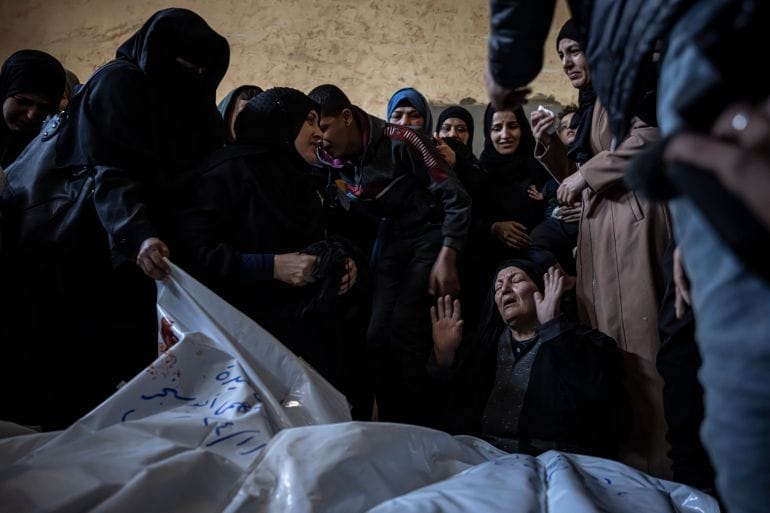
For three months now, I have lost sleep, consumed by a furious or despairing grief. It is a Democratic president who not only watches the Israeli military indiscriminately bomb hospitals, refugee camps, and neighborhoods, killing tens of thousands, the majority of whom are women and children, but who asks his legislators to send the Israeli military more weapons—in particular, something called a “hellfire” missile. I have left messages daily with my representatives, pleading with them to condemn the killing and to do all they can to stop it. They’re listening, I’m sure, and they’re choosing, like so many of their predecessors, silence, likely a cold calculation for political survival.
So it is now impossible to ignore the active participation of my government in genocide. Everything else seems to fall away. I find myself and this political class, and these politics, severed. It’s hard to tell, at times, whether I see more clearly, or have just turned away.
The one dispatch from Palestine I have been unable to get out of my head describes a man walking into a hospital holding several shopping bags, which contain what remains of his son. He tells doctors that he didn’t know where else to go.
If my political awakening began with the election of Donald Trump, perhaps it ends here, not knowing where to go. These days, the only thing that buoys me is the indefatigable hope of the Palestinians suffering such impossible horror, every hour of every day. If they can go on and keep hoping, so must we all. But it is a hope awakened by an understanding of my country as a shameful, evil thing. So while I hold on to this hope, I too do not know where to go.
Medical Aid for Palestine: https://www.map.org.uk/
Palestinian Children’s Relief Fund: https://www.pcrf.net/
Writers Against the War on Gaza: https://www.writersagainstthewarongaza.com/