Tuesday 113: Unfollow
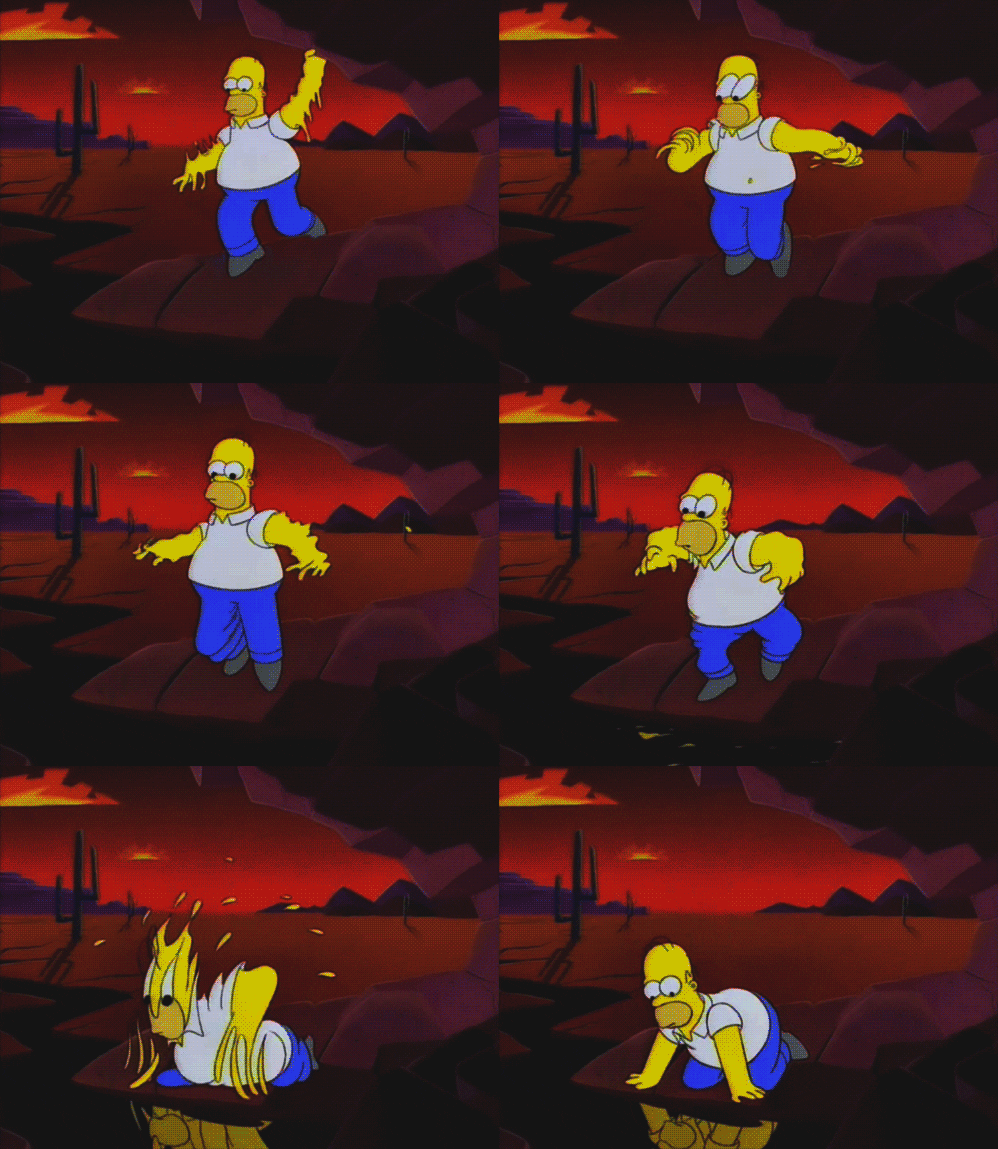
After writing my last blog, I noticed that I lost a few subscribers. I’ve made no secret of my support for the liberation of Palestine, which is a contentious stance in some circles, so the dip in my already modest numbers was unsurprising, and of course everybody is free to read or ignore whatever they want. It’s also entirely possible that after a significant break from this style of writing, my prose just sucks, and a few people thought as much and had had enough of me coughing into their inbox every now and again.
Whenever I take up a subject like Palestine, I’m driven to a fair amount of research and reading—much more than appears in the final blog, because at the end of the day, I’m neither a scholar nor a critic, I’m just a writer and a civilian who lives in the world and feels things and processes best through writing. Sylvia Plath wrote, “The blood jet is poetry; there is no stopping it.” This is one of the best ways I think my relationship to writing can be described. It isn’t ecstatic, exactly, but it’s a necessity.
Whether it’s essay-adjacent, poetry, or fiction, my work has lately tended toward the political, in part because it’s a preoccupation for me, and in part because I recognize that the recent American mode of creative education—in my opinion, anyway—overvalues the expressionistic and humanistic to such a point that work can become atomizing, alienating, and “just art.” The whole Jackson Pollock modernist “it’s just a bed of flowers” thing has its appeal and its place, sure, but art has to have a greater purpose than that. I know lots of recent and celebrated work has dealt with the political through the lens of identity and subjectivity, and the attention to marginalized voices in itself is a political project, but much of the work remains mediated through the speaker in a manner that’s rooted in American confessionalism. This isn’t to say that it’s bad work. A lot of it is really good, but there’s a collectivist muscle that’s untrained in a lot of American work, and I have as much of an interest in pursuing that as I do in exploring the avant garde and trying to find, at long last, a voice that feels authentic.
So while the majority of my serious work is focused in poetry and fiction, the dreaded “personal essay” has a purpose for me, artistically, because it occupies a space that the other work can’t. It’s a way of looking directly at a thing, confronting it before deconstructing it, flipping it on its head, putting it through a CAT scan, or covering it with foliage, detritus, or day-glo paint.
Though I consider myself a socialist, I’m uncomfortable with confrontational slogans and labels in general. I think a lot of people come to leftist politics out of a sense of anger and injustice, and while valid, I think it’s important that one’s politics evolve beyond that—especially if you’re an artist. Socialism (and ideologically, communism) offers hope to me because at its core, it says, “there has to be a better way.” I have neither the background nor the desire to debate the finer points of the realities of policy, but I also believe that most people who find themselves so vehemently on either side of the aisle don’t really either. If I have a guiding political belief, it lies somewhere in Adam Smith’s oft-quoted:
All for ourselves, and nothing for other people, seems, in every age of the world, to have been the vile maxim of the masters of mankind.
I see this everywhere. Just yesterday morning, watching the local news (I know, I know) I saw it in the lazy, idiotic, hateful rhetoric of a New York congressman, incensed at the temporary relocation of migrants to a high school gymnasium because a violent winter storm threatened their tent camp. As a simple citizen, in some ways I get it. Every day we experience firsthand the effects of inequality and poverty. It weighs on you. Even as one of the fortunate—the housed, clothed, employed, and comfortable—you’re confronted daily with the face of abject suffering, and you’re not always going to know what to do with it. I think one thing you can do, in this position, is not to stifle or ignore or repress the anger or frustration you experience, but to rather recognize it for what it is: a fear, maybe, that you’re closer to someone else’s suffering than you are to security in your own comfort. Or a rage that the institutions you trust to abate or limit suffering do not function and have no intention of doing so. Use this perspective to power the belief that a better world is possible. That a world in which Smith’s vile maxim is subverted and destroyed can be our world. This begins with a collective artistic vision grounded in love, in humanity, in the most essential, elemental building blocks of what it means to be free, to be safe, to be loved and to experience a bonded kinship with other people.
For me, that’s the point, right? This is where the political and the artistic intersect, and need one another: No art without purpose, and no purpose without art. This is why we feel the same swell of humanity when we see a political protest that we do when we hear a beautiful piece of music or read a moving poem for the first time. To be moved is an exercise in both human and political mediation.
In any case, thank you for reading along while I try to figure all this out.
Jean Cocteau once said, “Poetry is indispensable!” And then he added, “If only I knew what for!”