Tuesday 119: It's time
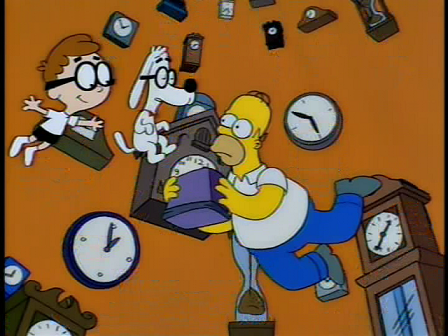
One of Carson Cistulli’s old poems describes time travel in its “cheapest, most efficient form” like waiting for a sharply hit ground-ball rather than charging it, and rushing the play. Invoking baseball’s “long, long season” in the same breath as he describes a particular approach to one of a single game’s individual, discrete actions reminds me of a notion I always think of, when I think about time: the idea that if I’m crossing a road, I first have to walk halfway across the road, and to cross halfway, I must first cross half of that distance, and so on, so I will never actually cross the road.
First proposed by a mathematician whose name I can never remember, this is a silly little thought experiment that primarily opens doors. For the materialist, of course, one does cross roads, and there is a traceable history of standardized time—a history where railroads feature with depressing frequency. The physicist or the cosmologist might ask at what point you literally can’t half the half—theoretical science is often driven by fun questions like, “What’s the smallest thing?” And the well-worn path of metaphysics from Proust to Woolf and Faulkner will ask whether time is happening at all, or, if it is, what its nature is and how that nature may exist outside of our ability to perceive it.
What made me think about this today wasn’t anything that deep, though: It was the realization that Dazed and Confused takes place in the spring of 1976, which in less than two years, will be 50 years ago.
Of course, it says something that I wasn’t struck by the realization that 2026 will be a big year of national partying for the USA’s 250th year of being (although the thought strikes me now that this will be way funnier under a Trump presidency than it will be under Harris; he may finally get that tank parade, or the statue garden), but rather that this movie, released in 1993 (31 years ago; I was 7) is now an anthropologic artifact of the USA and all its youthful promise half a century ago. That I recognize myself, my desires and desperation and all that animated me in my youth, in something this old doesn’t say so much about Richard Linklater’s transcendent, universal vision of teenage life, but rather that this vision of US existence persisted for so long, and has now passed.
My grandfather once told me that, as a child, he met a Civil War veteran. In the 2026 celebrations, I think it’s safe to assume that many parents will quietly instruct the nation’s current first graders to regard the few remaining, ancient veterans of the Second World War; this generation of children will be the last to know those who liberated the concentration camps of Europe. Dazed and Confused takes place soon after the end of the war in Vietnam (a little more than a year has passed). The familiar, broken, grizzled, eternally boyish veterans I came to understand of that war are old men today. What’s this all mean? Time passes and time sneaks up on you. When I played baseball, one of my favorite things to do was to field ground balls. It was a game within a game: When to move forward, when to move back, whether to go to your backhand or to move in front of the ball, how to set your feet to time the throw properly, always to start low and move up on the ball, how a ball with backspin slows, and a ball with topspin can accelerate, the existential mantras from coaches: See the ball all the way into your glove… Play the ball; don’t let the ball play you…
I want to say that time passes differently now, that everything’s sped up, but I don’t know how convinced I am. A ground ball is a ground ball and always has been. I’m still young, but I’m no longer a youth. And it saddens me not because my own moment is past, but because I have the feeling that something essential has been lost; that the US of Dazed and Confused represented the last vision of any real good or meaning for independence in our society. It was funny and righteous and it was for everyone (how can a Marxist see anything but class consciousness and solidarity in the film’s motley crew of jocks, burnouts, nerds, and dreamers?), and it made up for the ways it wasn’t so clear-eyed with an essential spirit of defiance and joie de vivre transposed through the lens of a wicked coolness. Randy might play ball. But he’ll never sign. Everything was in front of him.
I’m not one of those perverts who thinks we can, or should, go back to our childhood—whether in 1976 or ‘93. To take nostalgia to that logical conclusion is to fundamentally misunderstand what nostalgia, and time, really is: The era you long for never existed as you remember it, and so it only exists insofar as it is remembered, and so the question is, how did it exist at all (this is where we get modernist, Faulknerian)?
It’s worth noting that another of Linklater’s anthropologic films, Slacker, does capture the US in the decades following Dazed and Confused (it was released first, in 1990, and is considered contemporary), and although Slacker shares an undeniable affection for the American people, it’s singed with broader disaffection, tension, paranoia; there is less exuberance here than in the driftlessness of the bicentennial. Maybe the US is waking up a little, if only, as we know now, into new and different dream states.
Thanks for reading Tuesday! Subscribe for free to receive new posts and support my work.