Tuesday 136: Wha' happened!?
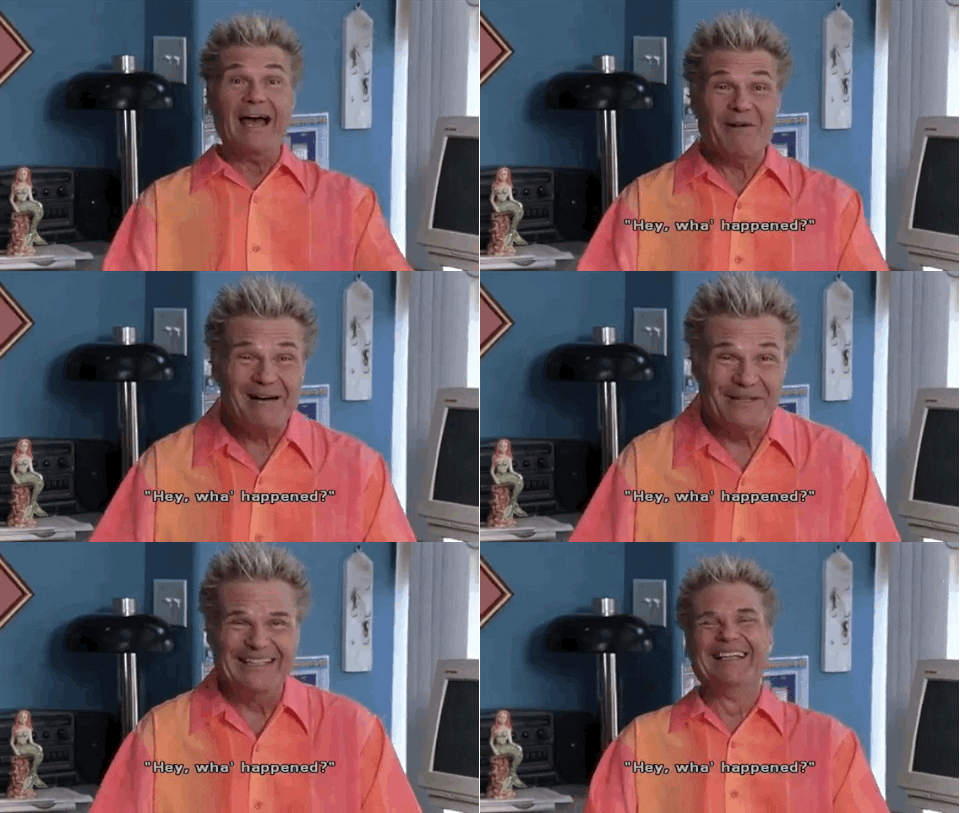
So clearly, the second half of poetry month did not go as planned. I got Covid—for what I honestly believe was the first time; I’ve never tested positive before—on my trip to Boston, and was somewhere between semiconscious and miserable for like a week. I’ve recovered now, thanks to all of your specific prayers, but poetry month was pretty much a wash, and for that, I’m sorry.
Like most people at all times, I’ve been trying to look at my phone less. I know we often talk about the “dopamine hit” of social media or whatever, but for me the phone invades my life differently. I don’t use social media much, so when I’m looking at my phone, it’s usually with a listlessness and pointlessness that borders on profound, or because I actually have to do something—pay a bill, schedule an appointment, etc. The behavior is still compulsive in a way that’s troubling: I don’t necessarily need every appointment I schedule. Perhaps its just that middle age warps your dopamine receptors in inscrutable ways (“Oh man you know what I gotta do is see a podiatrist, hell yeah!”).
Since recovering, I’ve often found myself waking up early, opening my phone, and scanning a newspaper app (either the NYT or the Boston Globe). The hope, every time, is that “the news will be good.” This is ambiguous, a confusion of modifiers, like “eat healthy” vs. “eat healthily.” I know that world events will not be “good.” On good days, the news, that is, the manner in which these events are understood and reported on, is good. There aren’t too many good days.
Recently, for example, The Globe spat out a series of analyses about Harvard, federal funding, Trump, and antisemitism. Two discursive editorial pieces looked at something called “Hillsdale College,” which proudly (or, more accurately, with the particular and unmistakable sanctimony of conservative libertarianism that is shallow, asinine, and annoying) refuses federal funding and doesn’t ask applicants about their race.1 The point isn’t what these pieces said, it’s that having read them, I didn’t feel any more knowledgeable or enriched. The Globe’s editorial board said something about their need to welcome and encourage a diversity of voices, namely conservative ones, and my head just started to spin.
I don’t know, you can’t dip your toe into genocide or fascism or extrajudicial rendition and also insist that nobody be mad at you about it. I’ve run out of ways to think about this.
But I digress: The point is that the media landscape is just so barren and perplexing these days that I find myself increasingly withdrawing from it, which really says something, because like everybody else, I’m addicted to it.
I feel like this is the state of tech culture at large: All the behavioral modification, designed reliance, and addictive UX in the world (the form) can’t overcome the rot of what’s being said (the content). That and silicon valley is fresh out of ideas, and everybody knows the AI bubble is ready to burst.
God, AI. What do you even say anymore? It’s technology for people with no imagination. I just hope that its moment at the helm of mass culture is brief and ultimately a good thing for art because it makes us all realize what’s essential about art, and that AI can never replicate it.
I recently finished Eurotrash by Christian Kracht2 and was reminded of just how important fiction is, and how good it can be, how surprising it can be, forever and when you least expect it to be. That the novel is a translation from the German is all the more impressive.
Kracht says of the novel, “It’s really about the impossibility of speaking. The decades-long, perpetual attempt of reconciliation. And the failure—the failure determined long before.”
AI can’t touch that kind of thought, is what I think I’m saying. Down with tech, up with books, baseball, and amateur distance running, all of which I’m happy to be enjoying once again now that Covid is out of my system.
This is really the more illustrative point. The notion is, “We don’t ask what your race is because it doesn’t matter,” which is an idea that doesn’t stand up to a mote of thoughtful analysis. It’s racist in practice because it makes the blind assumption that we live in a completely fair, just, meritocratic world, when the reality is, ignoring race is the best way to tacitly reinforce the most pernicious structures of racial dominance in America. (Actual Hillsdale demographic information is hard to come by, and I’m not going to dig too deep, but take a look at their basketball team for a rough idea of what the deal is there.) If they make a big show about not asking their applicants what their race is, what conclusion does an overwhelmingly white student population draw? This is eugenics with extra steps. These people are morons. Anyway. ↩
Good enough to immediately buy Imperium and The Dead, both also by Kracht, upon completion. ↩