Tuesday 3.20: The Michigan
In the interest of finding a challenge despite the complete absence of races for the last few months, I decided to attempt a running workout called The Michigan, which I read about in a running magazine. This is how it’s laid out:
- 1600m at 10K pace (essentially a 1-mile warmup)
- 30 sec. Rest
- 2000m at “tempo” pace
- 1200m at 5k pace
- 2000m tempo
- 800m at 3k
- 2000m tempo
- 400m as fast as you can without throwing up.
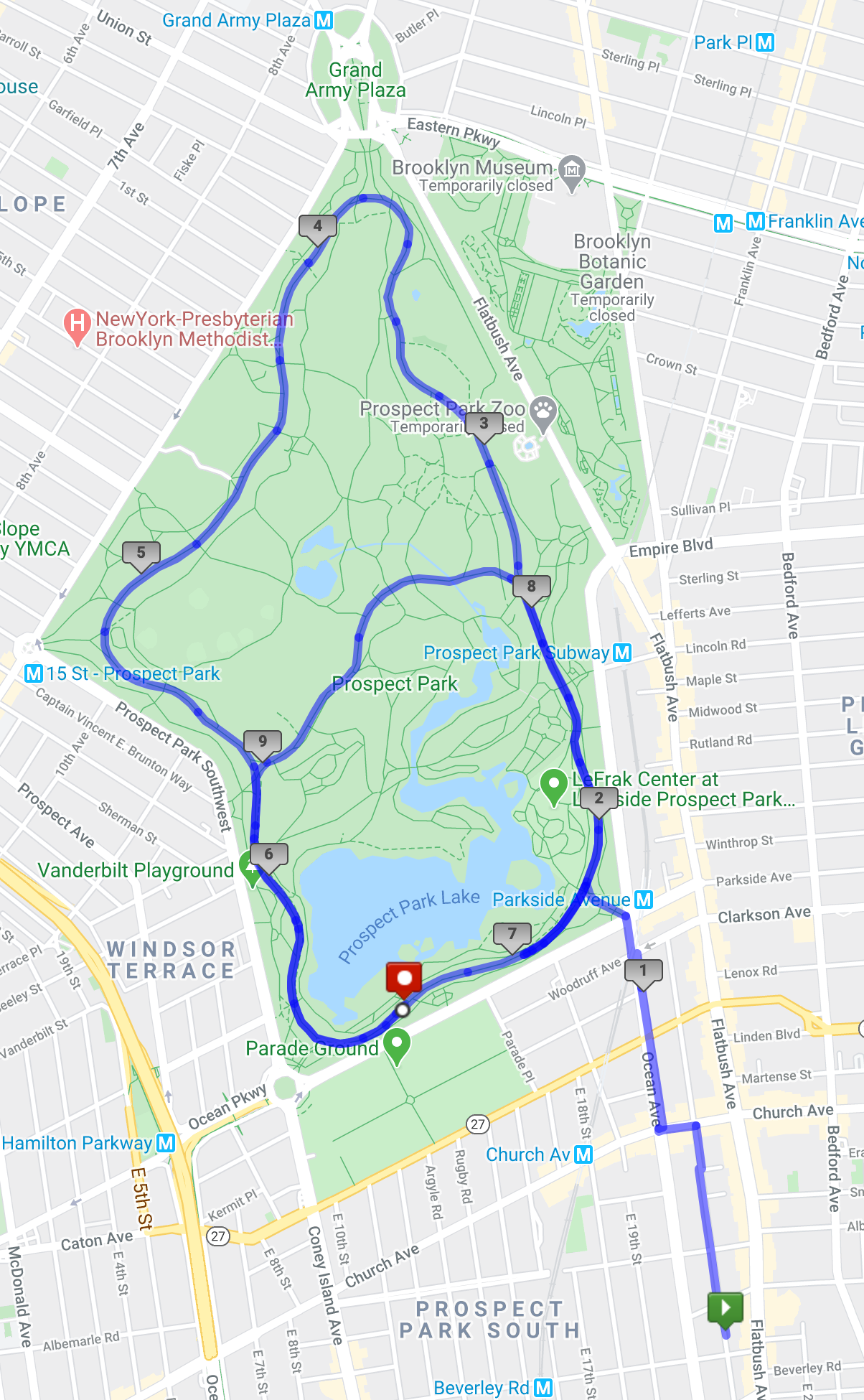
Some quick Prospect Park Googling showed me that if I ran to the Southeastern entrance at Parkside Ave. and backtracked west to complete the first 1600m, I could run the first 2K tempo up the dreaded East Drive Hill, beginning the hard 1200m pace run around Grand Army Plaza. I’d finish that 1200m at the band halfshell on West Drive, then run the following 2K tempo run to the Peristyle on Parkside Ave. From there, it’s 800m from the Peristyle to about the Concert Grove back on East Drive, then the final 2000m from the Concert Grove, uphill through Center Drive, down the West Drive hill again to a spot I loving call Muddy Corner. The last 400 runs from Muddy Corner back to the Peristyle, where I can collapse. The whole thing comprises a complete Varsity and a nearly complete JV loop of the park, and looks like this:
The Michigan is a classic 10K workout because it follows a staggered, somewhat odd and incredibly taxing pattern. For the first 1600m, you’re getting into your comfort zone, loosening up, etc. From there, you want to push yourself for the longest period you will do so consistently throughout the workout: 2000m. Of course, the fucked up part is that if you do it right, you’re either running hard or harder, so for my first attempt I built 30 seconds of rest into each section, to get used to the intervals. After the first prescribed break, that 30 seconds generally morphed into like 90 seconds. It is not a pleasant workout.
So after a settling in mile and 2000m at your standard, set pace (which, OK, I’m running at a comfortable and very approximate 8 min/mi my first few times out) you run 1200m at a 5k pace (which for me, on a good day, is in the vicinity of 7:15 min/mi, and I am nowhere fucking near in terms of fitness), followed by shorter, quicker intervals of 800m and 400m, each with one of those settled-in, 2000m tempo runs interspersed.
So essentially, you’re picking your spots over a combined 10,000m. Settle in for 1600, start rolling for 2k, then at 3600, you push the pace for 1200m. Settle back in to cover the halfway mark of the race from 4800m to 6800m, then make a more dramatic push from 6800m-7600m. From 7600-9600 is probably the toughest leg of the course, for me because about half of it rolls slowly uphill on my route, and if you’ve done everything right, you should be moving at the same pace as you were 6000m and two pretty significant sprints ago. You close the workout with a hard 400 and again, try not to throw up.
So breaking down the sprints, you’re pushing your pace to varying degrees for 3/4 of a mile, 1/2 mile, and 1/4 mile. If you’re in shape, you should be able to close the race with an honest-to-God, give it whatever you have sprint (anything sub-1:30 for me would be fantastic, and lol, I do not have it.)
On paper, and in my imagination, it’s pretty elegant. I pictured myself rolling through the park’s major and minor hills, which at this point in my Prospect Park Running Career, I know pretty well. I imagined the thrill of that last 400m, the feeling of a burning in my legs that goes cold as I expend the last of whatever I have left, settling my breathing as best I can, repeatedly going through my reluctantly adopted personal mantra and envisioning Billy Mills snapping his fingers, “If you can just be that much faster…”
None of this, of course, happened. My first mile felt pretty good, though it did push me a little farther west than I expected it to, throwing off my distance estimations for the rest of the run. From there, I was able to maintain a relatively normal pace (about 30” per mile slower than the tempo pace prescribed) for the first 2000 and… also for the first 1200. Pushing my pace south of about 8’ per mile proved difficult not matter which section I found myself in, which I realized was in part because I’ve trained myself to think in miles rather than kilometers. It also became clear pretty quickly that 2000m—about 1.25 miles—is a longer base distance than I’d imagined.
For every 2000m section, for instance, I noticed that I could clock the first 1600m (about a mile) around 7:40. The final 400m of the interval, however, would always dip, and dip significantly, to anywhere from 8:10 to 8:20. That’s bad, but it’s fascinating in a way because it speaks to a muscle memory that I’ve unconsciously developed. I know a counter-clockwise loop of Prospect Park pretty damn well at this point. I know it’s 0.65 miles from my apartment to the Parkside Ave. entrance, and I know how to hit my third mile just as the Grand Army Plaza downhill begins. But give or take an extra 400m from that routine, and suddenly I’m all over the place, completely inconsistent, discombobulated, gasping for air. And it’s almost all mental.
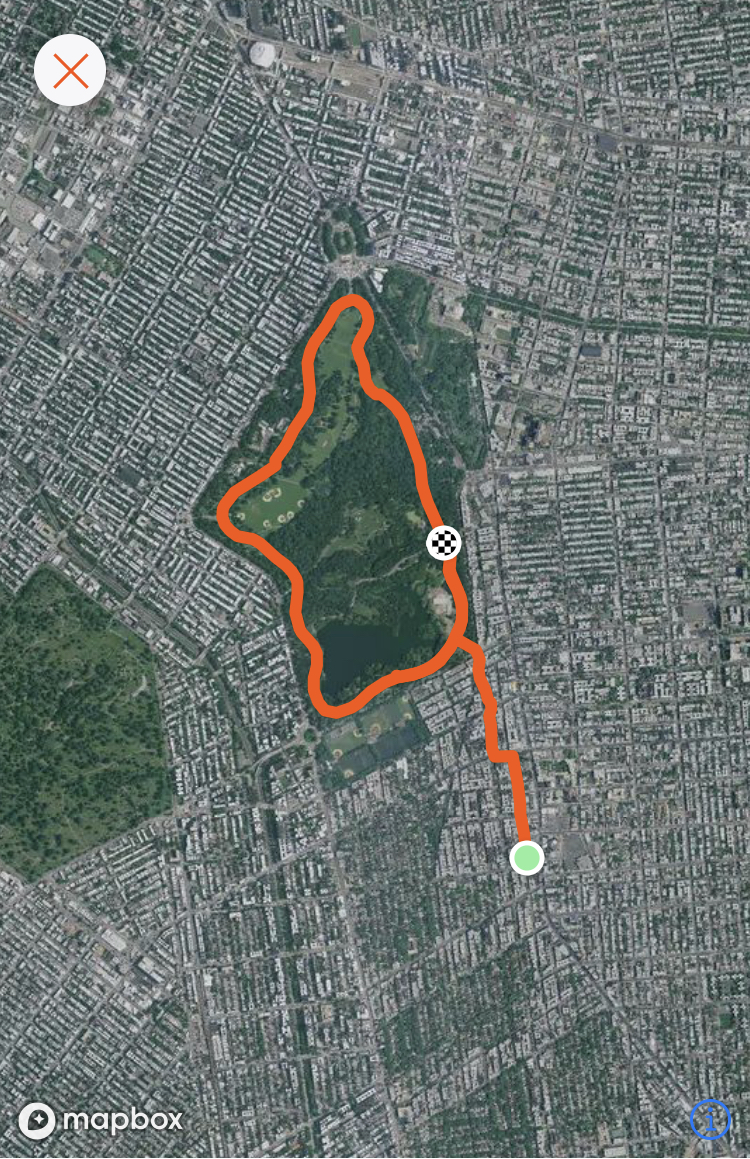
As you can see, I didn’t finish The Michigan on my first attempt. After breaking the the 800m step into two sections (each of which I ran at a respectable 7:15 pace, I would like to note) I was washed. Badly dehydrated and fighting back bile, I collapsed on some grass and sweat like a maniac while various compartments of my brain throbbed and pressed on optic centers or whatever happens. I had 2400m left in front of me, about 800 of which I know to be uphill, and it just wasn’t going to happen.
Later, and somewhat defeated, I did a little more reading about The Michigan and it’s legacy. Invented at the University of Michigan, the workout’s core—a 2000m tempo measurement—was born because that’s the distance of a lap around The Big House, UM’s storied football stadium. Steve Prefontaine is commonly cited as an originator of a workout that integrates both a tempo and 5k/3k pace sections (that “hard” and “harder” combination), but the Michigan itself was invented by Michigan track coach Ron Warhurst, who goes on the record just about everywhere saying, almost apologetically, that “the star of the workout is anyone who can finish the workout.”
I feel a little better, after seeing that. And I feel a lot better after reading some quotations from Michigan runners:
“I hate that workout.”
“I didn’t finish one until my junior season.”
Granted, these guys are running their warm-up mile at 4:15, and even just running one mile as fast as I can, I’ve never broken the 6-minute mark (though I did run a 6:11 with a sinus infection at the Fifth Ave Mile, so I bet I could do it someday). Their experience far outpaces (ha) mine, and there is no comparison.
I haven’t tried the workout since that initial attempt, though I hoope to have it lined up in the next two or three weeks. In the absence of any real races, it can be hard not to get bored with the normal running routine, and the Michigan is nothing if not a challenge.