Tuesday 3.26: Deep to center
Last year, the Red Sox ended their disappointing season with a walk-off win against the Baltimore Orioles, Mookie Betts racing home as Baltimore’s right fielder hesitated throwing a ball back to the infield. It was a exemplary play for a generational talent, showcasing that extra something that makes him one of the game’s best players, with an understanding of the game so innate that play seems to move slower for him than every other player on the field.
(*NB: Though we all know how slow it is to spectate, baseball is, in its execution, often an incredibly fast sport. If you watch the play I’m referencing a few times, you can see how quickly play can devolve into chaos at even the slightest confusion or hesitation, in this case a momentary lapse by Wilkerson in right field, which Betts takes advantage of in an instant to score the game-winning run.)
It was the last time Betts would be seen in a Red Sox uniform. Instructed by an ownership group that also counts Liverpool FC, NASCAR’s Roush-Fenway Racing, and The Boston Globe among its assets to get the Red Sox annual payroll beneath the MLB’s luxury-tax threshold, General Manager Chaim Bloom shipped Betts to Los Angeles for outfielder Alex Verdugo and a couple of prospects. One of them is named after Derek Jeter.
In a Covid-shortened and admittedly absurd MLB season, the Red Sox went on to post MLB’s fourth-worst record at 24-36.
The Dodgers went a league-leading 43-17.
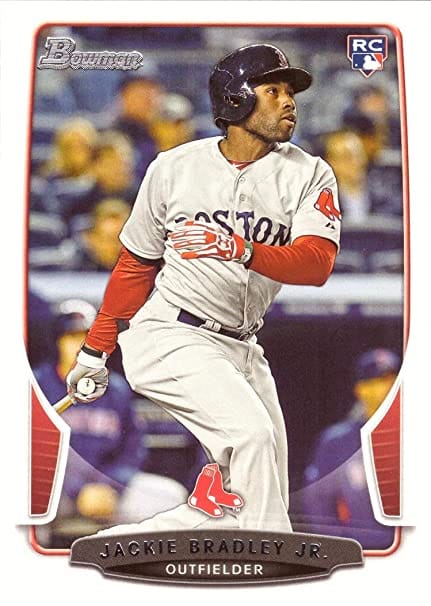
For many, many reasons, this has been a year to forget, but I was reminded of the way Betts ended his career in Boston yesterday, as I watched the Red Sox limp to the finish line, and Jackie Bradley Jr. went 3 for 5 with a double and a home run (he was a triple shy of the cycle), adding a trademark spectacular catch in center field in what I have to believe is probably his last game as a Red Sox.
Bradley is a reliably perplexing player. He’s streaky, and it seems like every year, I become convinced (justifiably, and along with just about every pitcher in the league, I might add) that he will never again be able to hit a letter-high fastball thrown above 92 mph. But he always does come around, sometimes quietly, sometimes with vehemence.
Bradley is nowhere near as good as Mookie Betts is, and his personality seems to follow the disparity of talent. Betts isn’t the showman that a Fernando Tatis might be, but his persona is outsized compared to the soft-spoken, introspective Bradley. Along with left fielder Andrew Benintendi, they formed the best and most fun outfield in Boston since Rice, Lynn, and Evans.
With Benintendi injured and Betts gone, the final year of Bradley’s contract had a somber tone from the jump. A fan base incensed at an owner who refused to open his wallet for the greatest homegrown talent in a generation, a pitching rotation content to write “TBD” on the schedule for at least half of a four-game series against divisional rivals, a lame-duck manager lauded primarily for handling a tank of a season with aplomb. The Red Sox were, as Dennis Eckersley, Jerry Remy, and Dave O’Brien so thankfully expressed in a few searing asides during yesterday’s final broadcast, “irrelevant” in Boston, for the first time in a long time.
And for Bradley, that’s really too bad. As rosters across the league sat games out in protest against racial injustice this summer, he found himself suddenly in the spotlight as the Red Sox only Black player. Though his team did eventually rally around him and postpone a game, I thought it unfortunate that more of his teammates didn’t come immediately to his side in solidarity when he began to speak openly about racism following the shooting of Jacob Blake in August—just days before baseball celebrated Jackie Robinson Day. (A telling anecdote about Jackie Bradley Jr.: As a Black ballplayer, he’s asked with what must be frustrating regularity whether he is named after Robinson. His jersey of course spells out “Bradley Jr.,” and he’ll usually, patiently point out that he’s named after his father.)
In the midst of the protests, I felt very strongly that the Red Sox should not trade him. It was a complicated position: For one thing, his trade value would probably never be higher. A free agent at the end of the 2020 season, he was unlikely to sign with the Red Sox at a rate they would accept. At 30, a speedy outfielder who lacks consistency at the plate is not typically a wise long-term investment, and for the (allegedly) rebuilding Red Sox, the hope was that a contending team with World Series aspirations would part with fair prospect value for a rental player who might be amenable to a one- or two-year deal in a happier clubhouse and a sunnier locale.
But where it made good baseball sense, it just didn’t sit right with me. Bradley came up in the Red Sox system, much like Betts. If trading Betts in the offseason because ownership was too cheap to pay him his worth hurt in one way, a potential Bradley trade hurt in another. It would have marked Bradley, who has spent his entire 9-year professional career in the Red Sox organization, as a simple commodity, shipping him (again, the team’s now lone Black player) to another team for a possibility of future talent, just days after racial justice protests roiled the sports world. Not a great look, as they say.
On the one hand, yes, every player is a commodity, and maybe we need to be reminded often of the business side of the game, its amorality, its callousness. But in the wake of the Betts trade, I believe there’s a chance that not trading Bradley may have saved the Red Sox’ soul. I’ve taken the streakiness for years, and in a moment when contention seems not to be on the Red Sox’ list of priorities, I’ll even take the decline to see Jackie finish his career in the park where it started. This team’s given us championships, and I have no doubt we’ll have our shots again, but I want to love it again.
I had this thought watching yesterday, as in a final, meaningless game of a dog-shit season in the worst year any living American can remember, Jackie Bradley Jr., the center fielder for the Boston Red Sox, tracked an Ozzie Albies fly ball hit directly over his head, 400 feet to dead center, and leapt.