Tuesday 3.28: What we talk about when we talk about work
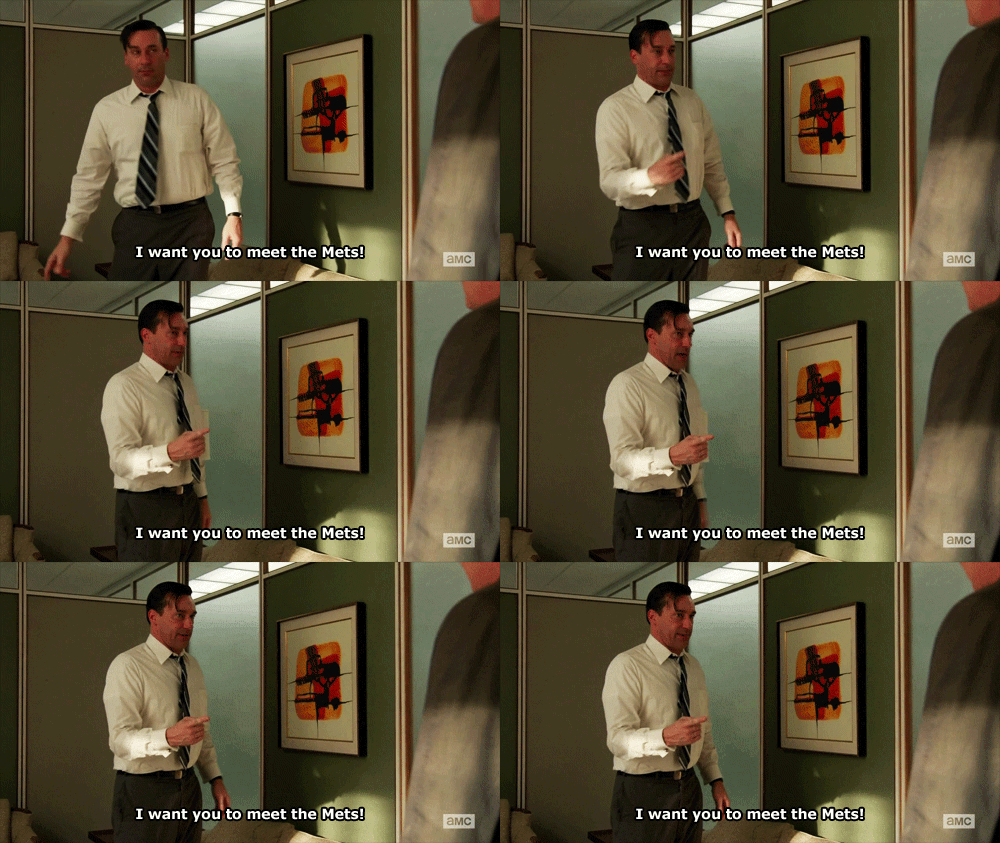
The only thing I ever wanted to be was a baseball player. Thankfully, when I was in the third grade, Mrs. Ryan helped us write, edit, illustrate, print, and publish our own stories. Mine was called “Toothman.” It was about a superhero with very strong teeth.
I wasn’t a very good baseball player, which was a significant barrier to becoming a successful baseball player. As I got older, I discovered that I could be, at times, a pretty good writer. More importantly, I learned (and am continually reminded of the fact) that to be a successful baseball player, you need to be really, really good at baseball, but the bar’s a lot lower if you want to be a successful writer.
Most people who really want to become baseball players will pursue opportunities in the game that are less central than employment as a player. While I was about as ardent a fan and baseball card enthusiast as anyone else, I wasn’t very interested in becoming a sports reporter or an analyst or even a scout. If baseball was going to be complete for me, if it was going to be my thing, I needed to be on the field.
I faced a similar problem as a writer in that the more I wrote, the more I became aware of that rather narrow, strict relationship with my writing. It wasn’t necessarily that I wanted to be traditionally successful, but I wasn’t satisfied unless the writing, the real writing, the real work, stood on its own two feet, conceived, realized, and executed precisely as I knew it had to be. The writing needed to be on the field; it had to play.
So more than anything, I read. And the best things I read were the things that excited me, that did things I didn’t think books could do. I liked to read things I didn’t get. Writing was about possibility, and if I was going to be a writer, I didn’t want to settle into some established mode—I wanted to be as daring as writers I read who shocked or befuddled me, or like the infielders who made plays I didn’t think infielders could make.
I didn’t really think about any of this when I first went about finding a job. I entered the workforce like every other recession-era liberal arts college non-graduate—listlessly—and found myself at a content farm, writing daily internet fodder for relatively low-traffic business websites that sold things like traffic-signal infrastructure to municipalities, and legal services to people who drive drunk. When it was a little absurd and esoteric, it was kind of fun, but the sheer volume of the work was exhausting. At the end of most days, I found myself simply written dry. I advanced into more editorial and managerial roles at that job, but I still never had the endurance to go home and do the real writing.
This is what drove me to advertising. Advertising, as I understood it, would surround me with like-minded people who spent a lot of time talking through things, coming up with clever ideas, writing, revising, designing, and editing collectively, but generally using half of their true artistic firepower to make ads. It took really talented people, I figured, with a really good understanding of the power of simple messages. I asked around, and got a fair amount of encouragement. I didn’t have any formal advertising training, but if anything, that seemed like a good thing. I quit my job in Boston, moved to New York, and after a few stressful months of weird freelancing, landed a job as a proofreader at a large agency. I was enthusiastic, and after about a year, started getting opportunities to write copy.
There’s a scene in an episode of Mad Men in which the advertisers consider a famous ad for a Volkswagen Beetle. The ad reads “LEMON” and there’s a small picture of the car. It’s clever (the ad), ironic, and speaks to the era, but what gets me most about the scene is that the group is critical, academic, and their opinions differ. Some think it’s funny, others hate or dismiss the ad because it goes against their professional instincts. Ultimately, it’s a scene to draw parallels between shifting of cultural norms of the time and their expression through ads (the characters could be talking about Jimi Hendrix, or Robert Rauschenberg), but the discourse retains a distinctly capitalistic conceit: At the end of the day, we’re just talking about selling cars.
This is the discursive framework that attracted me to advertising. I thought of it like practice. Using all the same muscles, but at half-speed, or working on footwork. I thought I had those muscles, already pretty well trained, and that advertising would help keep them in shape. I knew I would be good at it, and, at least on my own terms, I was.
But what I discovered about the industry, honestly, was chilling. Maybe I was stupid to think it could be any other way, but it was lacking what I thought was an important conceit—to most of the people I worked with, what we did in the office was the real work. My inexperience, in practice, was seen as not just an impediment, but at times a threat. Doing things on your own terms opened the door to a perspective at odds with the sincere, compulsory reverence for brands, products, and the free market.
When I wrote for a content farm, it could take my body from me at times, but this took my soul—it wanted, needed you to buy in. We had to believe that as a company, we weren’t making clever ads to sell products, we were literally changing the world, and I was forever looking for the solidarity of someone who recognized that we very much were not changing the world, at least not for the better.
All the cliches about working in advertising are accurate. It’s petty, narcissistic, superficial, vapid, toxic, nepotistic, and exploitative. I have nothing good to say about it. I made some very good friends, but we are friends in spite of advertising, and I met far more people who disappointed me. And although I liked to think that at all times I was above it, that I was somehow outside of the people and the culture that surrounded me, the work contributed to a version of myself that I am deeply ashamed of, and one that I will never be again.
But the deepest problem, I believe, is not this personal. It’s social, cultural, rooted in our decreasing ability to distinguish between performative, projected emotion and any real, internalized psychic need. Borges talks about a map drawn so perfectly to scale that we can no longer distinguish between the map and the territory; Baudrillard describes the parking lot at Disney Land; Zizek sums it up with the simple, poignant, “Freedom hurts.” I think they’re all talking about the now willing alienation, the accepted tenets: that which is easier is more favorable, that which is comfortable is more secure, that which is more personal is more intimate.
How this relates to the presence of work in our lives is multifaceted. The ascendance the techno-capitalist and of of free-market “innovation” culture has seemed, to me at least, to overshadow the steady decline of the labor union as an American institution, a meager increase in wages relative to the exponential increase of American productivity, continuing wealth inequality and a healthcare crisis perpetuated in part by a complicit professional class. The more we find ourselves at work, the more corporate culture feels the need to convince us that the real work is the work we’re doing when we’re there, that fulfillment and meaning must derive from this increasingly performative working, because working is now bereft of a former connection (albeit maybe paltry and tenuous) to some real psychic fulfillment, and must be replaced by a false sense of community, purpose, and meaning.
I don’t want this to turn, in the end, into a half-assed essay about how your boss isn’t really your friend and new forms of labor exploitation have been around for hundreds of years, they just wear different clothes now, &c.. The point I want to make is that I believe it’s possible for us to find some soul in every kind of our work. As much as I agree that workers should organize and wield some fucking power in this conutry again, I think it’s also a good idea for them to try to articulate just what they ultimately want to get out of working. What does security, independence, and purpose mean for the American worker today?
The poet Philip Levine, who’s most known for heart-wrenchingly articulating the manner in which Americans do and do not know what work is, once said that when working in factories as a young man, his coworkers would sometimes ask him what he did. And when he said he wrote poetry, they never laughed at him. I think about this often, although it’s ultimately unsurprising. I don’t know whether anybody ever laughed at me, but it wouldn’t surprise me if they did. I no longer believe there’s any poetic muscle that advertising can strengthen. A poem must be honest.
I’ll put it this way:
It’s hard for me, when I pass an empty baseball diamond, not to stop. I like to feel the chain-link fence between my fingers, looking out across the field. I might walk out and stand in the infield, kick some dirt, or rub it on my hands, and look around. I’m drawn to these places. Their geometry makes sense. I like the way the sound and smell. They make the world sharper, slower, quieter. And when I think to myself, “The only thing I ever wanted to be was a baseball player,” a voice answers, “That is all you will ever be.”
And it’s unbelievably difficult, and I’m not saying it all that well, but whatever that is, to share it is the work of a poet. That’s what work is.