Tuesday 3.32: Pick Flick
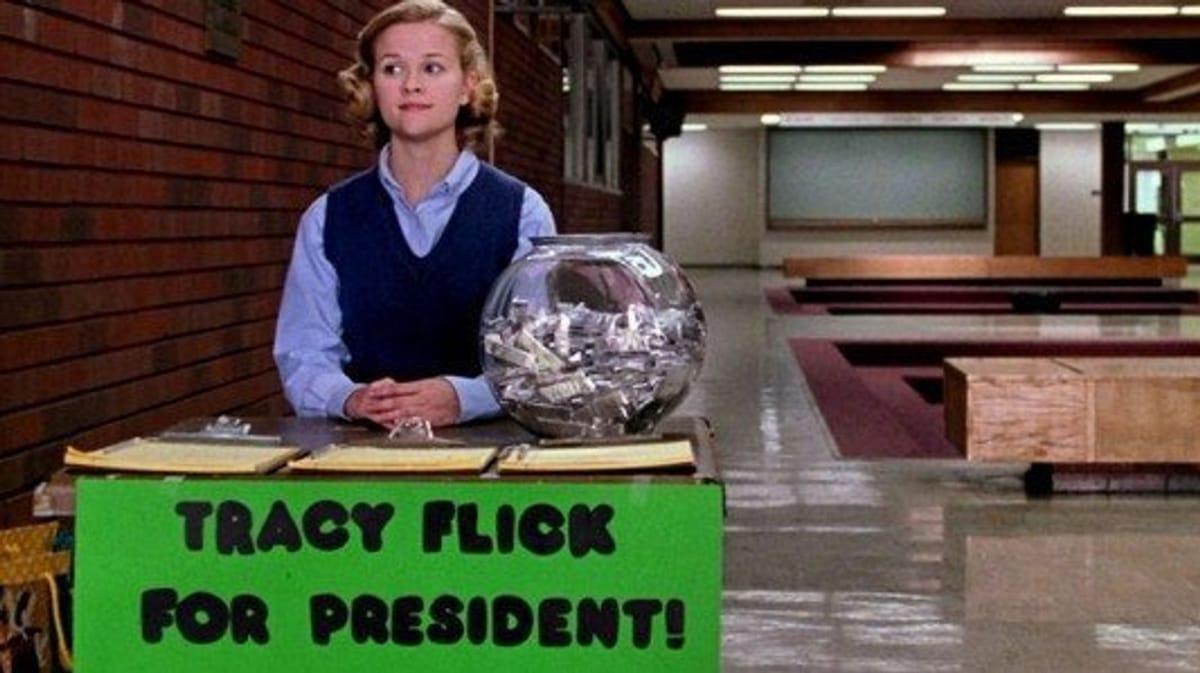
For all the righteous ecstasy of watching Trump lose, the relief of a vote that told us a not-exactly-insignificant majority of people in this country seem to prefer decency and capability to abject cruelty and stupidity, Joe Biden’s victory doesn’t really feel like a victory to me.
It feels sort of like kicking a field goal before halftime to make it a one-score game, or putting up a few runs in the fifth so you’re down 7-4 instead of 7-2. You’re not in the lead, but you’re within striking distance.
As time goes on, I imagine the experience will be more like that of a Jets or Cowboys fan watching the Eagles beat Tom Brady’s vile Patriots in the Super Bowl. You’ve resigned your life to a pointless fandom, but at least somebody stuck it to that guy.
My earliest politically adjacent memory is my mother’s trip with her sister to Washington DC for Bill Clinton’s first inauguration in 1993. She still says it was perfect. She took the train from Boston to Washington, which was as exciting at the time, I suspect, because of the renewed 1990’s interest in rail travel (a cultural precursor to the weirdly interpreted and ill-advised return of all things “retro”), and she came back with all kind of Socks paraphernalia for my brother and me, which we loved, and probably still have in a drawer somewhere.
Clinton was the first Boomer president. This was, of course, something different in 1993. Born to parents who survived the depression, revered Roosevelt and the New Deal, and won the Second World War, Liberal Boomers had gone through a radical, uncertain youth in the 60s and 70s. They were the first group of people in a long time to confront widespread distrust of the government, and as that led to the capitalist excesses of the 1980s, the AIDs crisis, The Gulf War, it’s remarkable they weren’t more widely disillusioned.
Clinton was the first president since Kennedy to have a poet speak at his inauguration (Kennedy had Robert Frost; Clinton, Maya Angelou). He cruised to victory with 370 electoral votes. He won states like Georgia, Tennessee, Louisiana, and Kentucky. For all Bush’s shittiness, his loss hinged most on the cardinal Republican sin of daring to raise a tax. (While he gained like 20% of the vote overall, Ross Perot pulled as many votes from would-be Clinton voters as he did from would-be Bush voters, and Clinton won over plenty of liberal Republicans.)
Clinton appealed, in a cultural sense, to the memories of those of his generation ready to embrace rational and substantive, if measured change.
From a cultural lens, the appeal of 90’s Liberalism is not unlike that of today’s Democratic Socialism (a redundant term, but that’s for a whole other thing). Both were rooted in the overarching belief in the possibility that fundamental change could drive toward true equality, and while 90s Liberalism’s reverence for the US as a concept is something that many of today’s progressives have moved past, it lives on in the notion that we are a nation that produces a tremendous amount of wealth, and it’s entirely possible to distribute that wealth in such a way that everybody has a pretty good life: like maybe that’s the American Dream.
I should pause here and note that this is woefully under-researched. If you’ve spent any time on Politics Twitter (which if you haven’t, you shouldn’t), you can no doubt imagine the self-righteous evisceration this kind of writing would justifiably get in the form of the dreaded quote-tweet take-down. But frankly I don’t really want to get too deep into electoral analysis or -ism theory. There’s plenty of that being done very publicly by people who are way hotter than me, and seem to have way more time on their hands to boot.
But if there’s something to take away from this gross oversimplification, it’s that even in our ecstatic, emotional political victories, there exists a chasm of policy between us and the political representatives to whom we hitch our wagons. It would be inaccurate to say that any of us can or should steel ourselves to stirring rhetoric and ideology, or the benefits of things like a diplomatic return to normalcy (with Western Europe, anyway), but it is not, in the end, what’s going to save us.
The recent dialectical vacillation (take that Sexy Communist Twitter) between liberal and conservative ideologies has led us to a short-term center where wars don’t end, rich people get obscenely rich and poor people get even poorer, innovation instantaneously becomes exploitation, countless people die of preventable infection, and the planet roasts like a coffee bean because this order is allegedly the best we can do.
Of course it will be better to see Joe Biden take an oath next January than Trump. It’s just too bad that when he stirringly talks about a turn to the future, he will undoubtedly reference an America of the past that never really materialized for anybody.