Tuesday 3.40: Get it?
A few years ago, I deleted all of my social media accounts. I wasn’t all that active of a user, and it’s never seemed important enough to articulate why I did it. The companies are evil, and it was something that mostly just made me hate myself. After some time passed and I gained the perspective necessary to confront the things in my life that were actually contributing to the self loathing, I got Twitter again.
Twitter helps me keep up with things like baseball, track & field, and stupid jokes. Its more substantive, allegedly consequential corners must be approached with caution: Politics is a hellscape, art and poetry are stupid, and economics I hope to God doesn’t even exist.1 So I carved out a little corner of the social internet for myself, and for the most part, it was fine. I don’t think more than 30 people “follow” me, and the most attention I’ve ever attracted has been for obligatory posts associated with volunteer work. This relative anonymity is necessary for a person of my age (35) on the social internet, because if there’s one thing my cautious return has shown me, it’s that social internet culture has passed me by.
Mostly, I just don’t get the jokes anymore. I don’t understand the rules of engagement. None of my opinions seem valid or relevant, and despite knowing perfectly well that it isn’t true, I always feel like I’m just not smart enough to be there. After returning, I spent a couple of days feeling sorry for myself because someone was mean to me about a baseball statistic, then I discovered he was a Warhammer enthusiast.2 Most people either have podcasts or will get naked for money, which strikes me as strange, but it’s a sentiment I would never risk sharing.
So I don’t get it, overall. But not getting things has always been my window into culture. Whether it’s a book, a movie, a painting, a TV show, I’m captivated and inspired by its more mystifying elements, which more often than not correlate to rigorous production, scholarship, or carefully measured and executed vision. An artist who asks a lot of her audience is often doing so because she put in a lot of effort herself. What’s immediate and arresting can grab you, but you need a little mystery, even confusion, to pull an audience in.
Now, my point is not that this is present somewhere in or on Twitter if you look hard enough. It’s not. I have to stop myself whenever I begin to think too much about social media because I believe it’s really easy to slip into the habit of doing so. It’s a phenomenon, sure, and it changed the way we interact with one another and with ourselves, &c. but it can’t be overstated how inane and silly and ineffectual it all is. It’s just this big stupid thing that we shouldn’t waste too much time analyzing.
With regard to this distinction between Getting It and Not Getting It, though, I think social media interaction can articulate the shifting parameters, and I want to try to explain how.
First, get a load of this tweet:
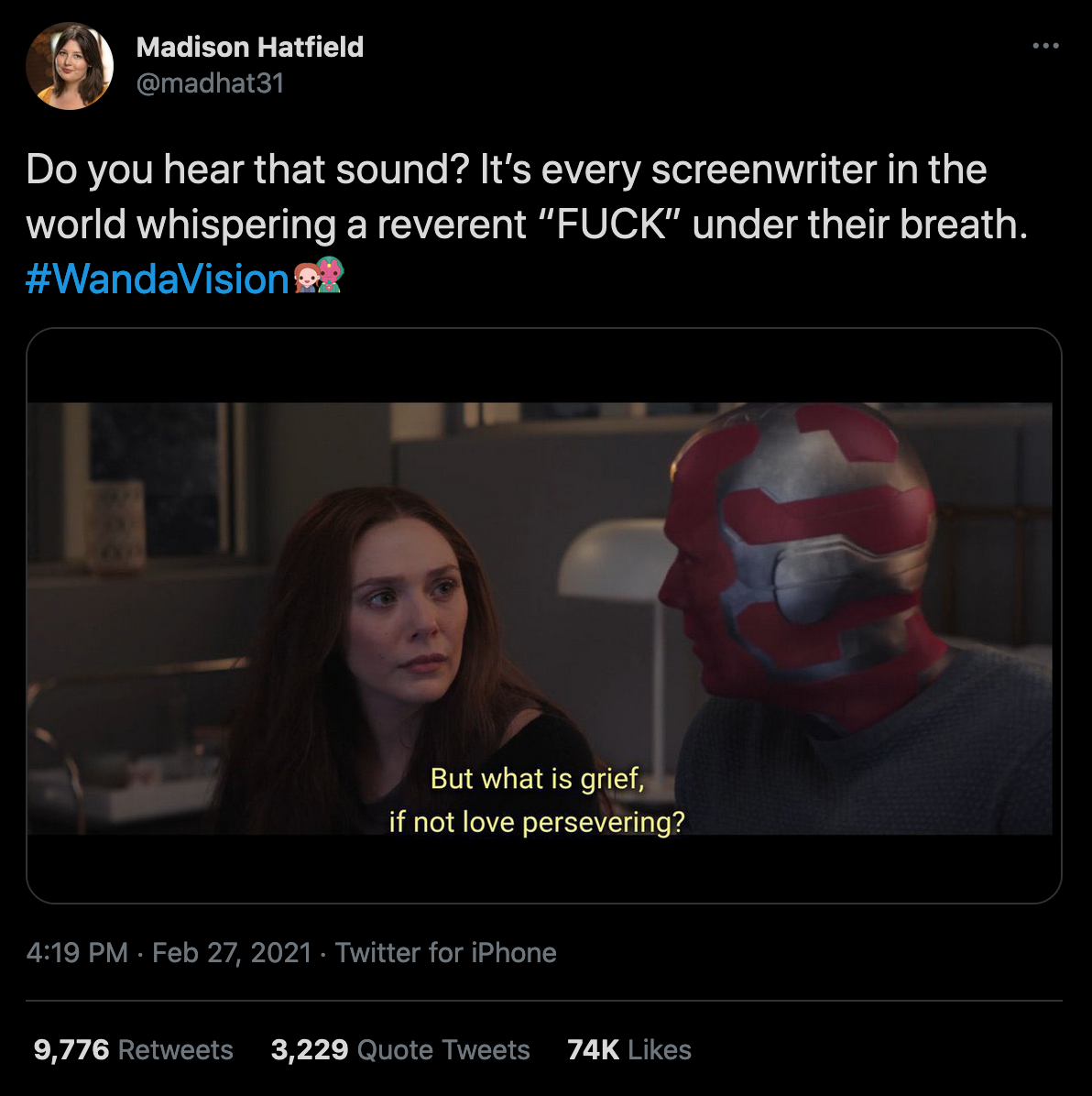
Some context surrounding my perspective: I don’t know exactly what Wanda Vision is, but from what I’ve gathered, it’s a TV show based on a comic book, and it’s a little weirder than your average superhero movie. Like most things on Twitter, it appears3 to have a respectable legion of enthusiasts, who are countered, to a man, if not by people who actively hate it, then by people who think it’s hackneyed and mediocre.
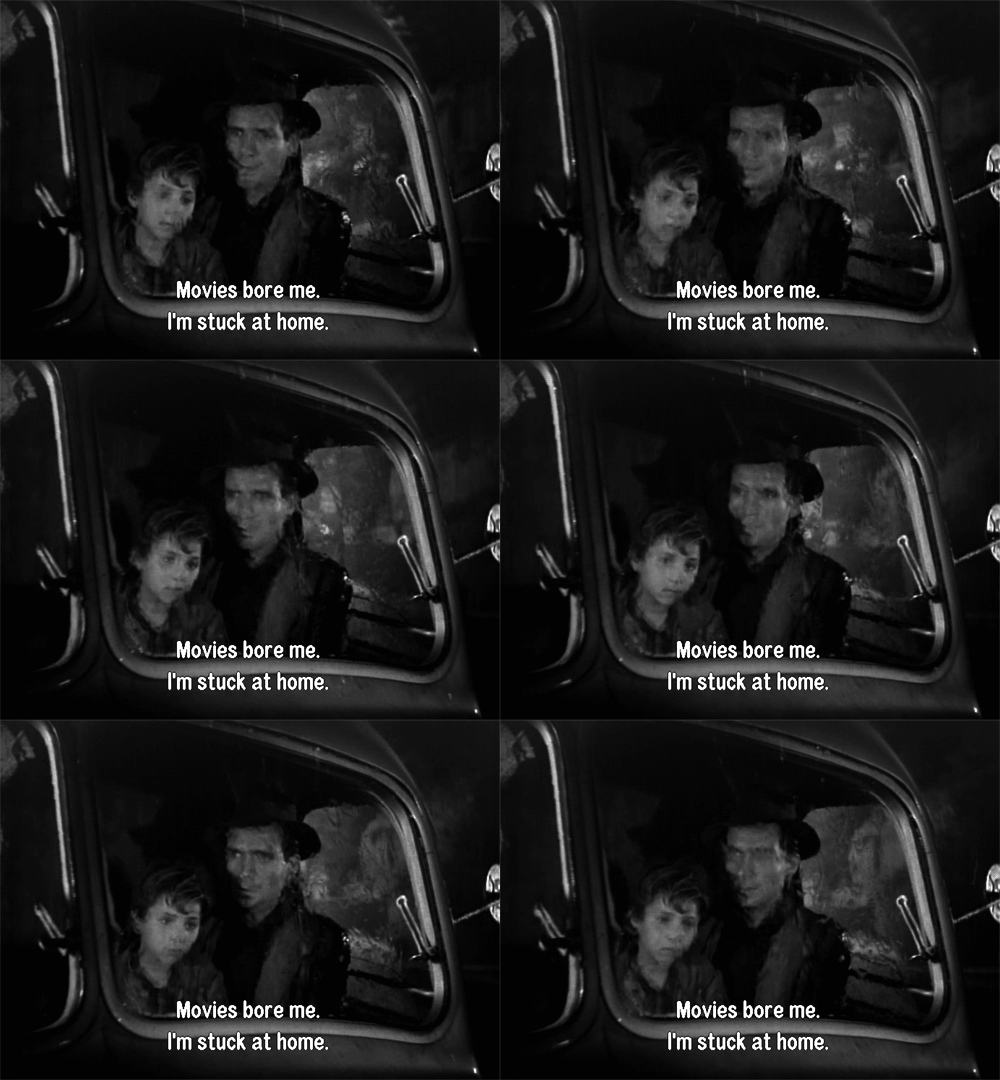
The tweet above has of course been parodied endlessly, the close-captioned image replaced with stills from, for example, meandering improvisations from the animated sitcom Home Movies, a cultural touchpoint for a certain breed of millennial. Part of the bit is the silly reverence of the comment itself. One characteristic of recent criticism is an insistence on identifying the transformative and transcendent elements of anything you might just like. Pop stars don’t release good albums anymore, they triumph, or “are everything” in common parlance.
But I don’t want to descend into this particular gripe. As it relates to this instance, it confirms my belief that most television writers are precious and simple in a way that really does create a reverential attitude toward this kind of lazy, reductive, abstract writing.4 And there is something appealing and comforting about it. I write this way a lot in my day job, weaving webs of meaning by establishing simple relationships between modern corporate abstractions like “innovation,” “agility,” and “empathy.”
It appeals in a way that values, above all else, effective communication. It’s good because you get it, and you get it fast. I used to believe that this is the product of the rampant commodification of art—efficiency as desirable or indicative of quality—but I never had a good answer for the fact that under capitalism, art is a commodity. How can it become more of a commodity?
The answer was articulated in Martin Scorsese’s excellent essay on Fellini, published in this month’s Harper’s. What has shifted, he says, is curation. The manner in which art is shared and appreciated.
Curation treats an audience like people. Curators develop and distribute or recommend art making a variety of humanistic value judgements5 from an informed, educated, experienced point of view. Today, the rise of the algorithm takes the place of the curator, but it bases its judgements from a perspective in which the audience, you, are only a consumer. It commodifies not art, but the way art is distributed, presented, and thereby understood.
Scorsese notes that the word “content” should always appear alongside the word “form.” One without the other is incomplete, irreconcilable. You can’t say anything about “content” unless you have been presented with terms of a reality in which that content exists. When you properly interlace form and content, you can make dynamic, nuanced statements that risk misinterpretation, and demand something of the audience. Content alone offers little and risks nothing. It’s declarative, and doesn’t demand even consideration. Its consumption is tied to quantifiable pleasure, which an algorithm is well suited to measure and distribute.
Scorsese caught some heat a few months ago because he talked shit about Marvel movies. I’m obviously on his team, but I can see both sides of it. You can’t spend 100% of your time with challenging art, and you’re going to be defensive about the stuff you like when it’s dismissed, even if you know deep down that it’s probably garbage. But at the same time, if films you’ve directed have won 20 Academy Awards, you can say whatever the fuck you want about Captain America.
The problem is that we’re not drawing the distinction, and I worry that we’re quickly losing the appetite for challenge. We’re missing the fun of not getting it. When I look at the jokes that have passed me by on Twitter, I’d like to be able to say that the kids are still alright, still chasing some weird bullshit. It doesn’t so much concern me that they’re gobbling up corporate slop. What worries me is that they defend it, believe in it, and seem to lack that essential curious muscle that drove me and my friends to seek out that stuff we didn’t get, discovering the thrills of ambiguity, failure, attention, effort, and difficulty, even if we were mostly just screwing around and collecting affectations.
I don’t worry that the kids are dumb, I worry that they’re not.
I worry that they know there’s nothing to get.
Don Hughes, who tweets @getfiscal is admittedly a bright spot. ↩
Twitter is a bizarro high school where the nerds are vicious and the jocks are really nice. That’s if you’re a guy, though. I think if you’re a woman, everyone is horrible. ↩
This is a whole Marxist can of worms that I’ll have to open some other time, but it should suffice to say that any statement of fact or metric or quantitative value like “virality” as it concerns a post is an expression or appearance, which is distinct and must be abstracted from its other realities in order to be understood holistically. But like I said, whole other thing, and I’m getting close to thinking about this shit too much. ↩
"Grief is love persevering” is the same as saying “Exhaustion is the absence of energy,” and if you play mad libs with the (unnecessary) construction, “What is___ if not ___ [doing] ___” structure, any three abstractions sound profound. ↩
It’s fair to say this is an oversimplification. People who look a certain way find themselves on lists much more often than certain people who look another way. But for the purposes of this comparison, I’m setting that fact aside. ↩