Tuesday 3.42: To My Shoes
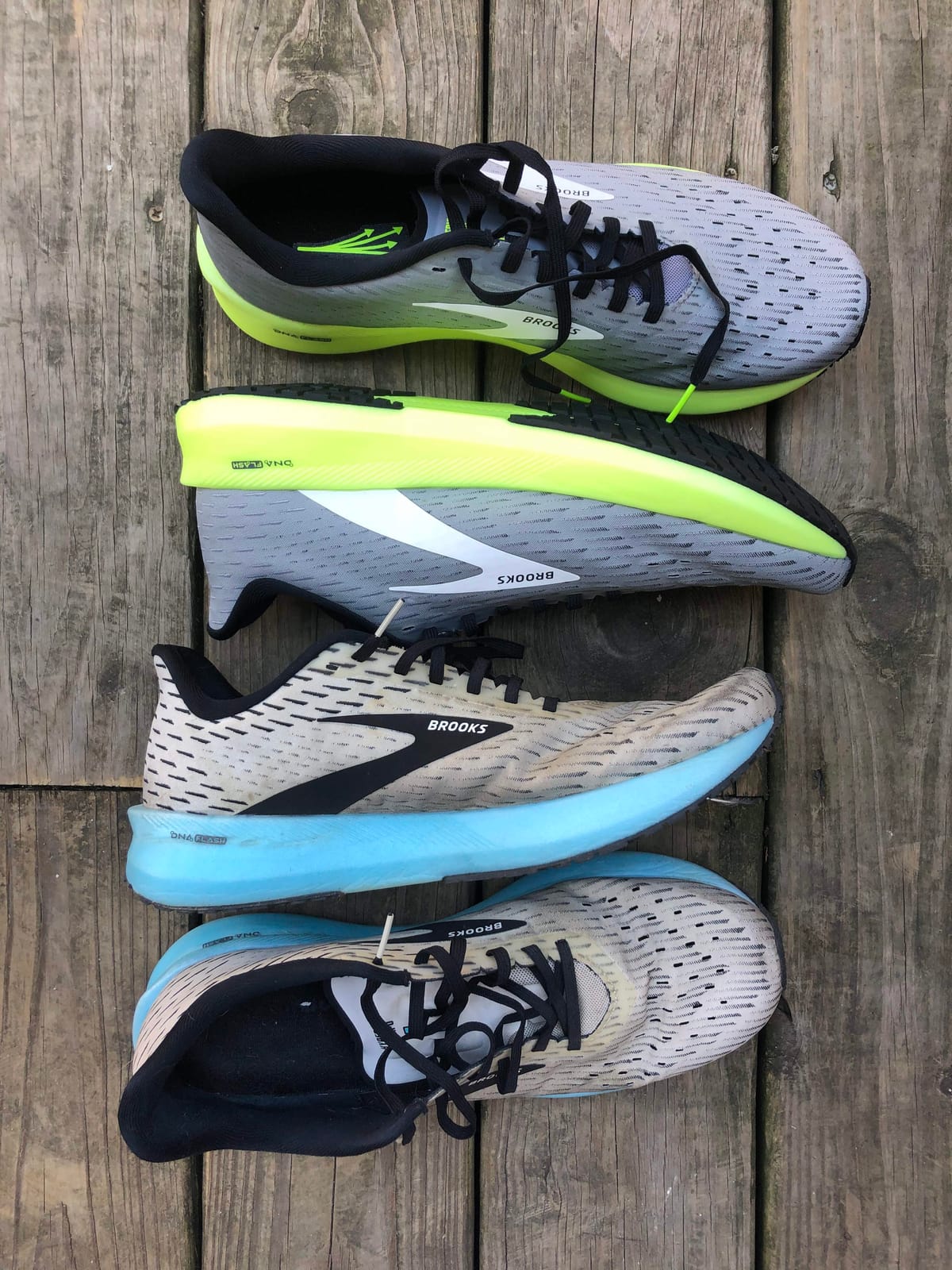
After 350 miles, the foam in my Brooks Hyperion Tempo sneakers (blue, above) has become condensed to the point that I can feel dead spots and irregularities when my feet hit the ground. This weekend, I ran for the first time in my new pair of Brooks Hyperion Tempo sneakers (lime green, above), ushering in a new running season, making new resolutions, &c.
When I was a kid, I remember being really sad when my parents traded in their Toyota Corolla. I was old enough to recognize that it was strange to feel emotionally attached to a very utilitarian, inanimate object, but too young to consider that the car represented all the things I’d done in and with the car. I looked at the dull navy blue of the dashboard and the gear shift, the already outdated tape-deck stereo, and felt sadness for the thing itself, not what the it represented, or the memories it might have held. The sense of loss was not abstracted.1
Now, I’m older. I recognize that as I hold these old sneakers in my hand, or eke out a few final jogs in them despite a nagging pain in my shin that I know will subside with a fresh pair,2 I understand that the desire to hold on can be attributed in part to the associations I’ve made with the object.
This was a hard winter. I didn’t get out for as many runs as I would have liked, but I also didn’t give up. I didn’t get any faster, or run any farther, but I dragged myself out of bed in the dark quite a bit, ran through biting cold, and was occassionally rewarded with the very singular silence of snow falling in on a silent, empty field. It feels very special, especially in New York City, to find yourself that alone, even for just a moment, in some park, and I hope we were all able to experience a few small instants like that, in whatever shape they may have taken, through what was the terrible winter of a terrible year.
But the shoes are also just shoes, and it’s in this sense that they’re hardest to throw away. I know the real emotional associations I have with running have nothing to do with what I’m wearing. The few times I think I’ve approached the transcendant state of bliss known as the “runner’s high,” I’ve understood that it’s essentially an understanding and greater sense of your body, and so eliminates pretty much everything else except “you” as a concept and as a physical expression.3
But if you’re doing something right, you’re going to feel this sadness. The shoes are a tool that served me, and well, and I look at them and think that I want them to live forever. I don’t want to run without them. I don’t want a new pair. Maybe it’s that I know I’m breaking down the same as they are, just not as quickly or noticably, and that to throw them away is to also know that every mile is another I can’t run again. But this still feels too metaphorical. It’s not, really. There is simply sadness for the thing.
The lifestyle of minimalism, obviously, has never appealed to me. On the surface, it makes sense. The notion of limiting your material possessions to simplify your life and de-clutter your mind and soul is nothing new, but the idea that it is somehow an escape from materialism, I think, is shortsighted. In a way, having fewer, somehow more essential material possessions is more materialistic than simply accepting the role that possessions play in your life. They may not mean anything beyond their use, and yet it will be hard to let them go, even when they’re worn and useless.
Everyone’s a materialist, but in today’s (somewhat waning, admittedly) zen-like minimalist trends, I see the sterile, dispassionate living rooms of my suburban adolesence. Impersonal, hermetic chambers that need more things—not essential things to be revered for a utility exceeded only by their impeccable, unassuming design, but just liked because the world is a messy, complicated place whose beauty should be reflected in its reality, not its phenomenological ideal.
And as beautiful as that snowy field was, I wouldn’t want to live in it.
In any case, I’m going to go for a run.
I think this is all Kantian (noumena/phenomena), but I don’t know enough to put it in those terms. ↩
I’d like to note that while I’m as particular as any runner with regard to my sneakers, I take care not to go crazy. I like this Brooks model a) because it’s not Nike (fuck Nike) and b) because it’s pretty bare bones. The foam is soft enough, but not plush to the point of being too forgiving. A new trend in running shoes seems to put a lot of emphasis on softness and design as key to injury prevention, and I’m suspicious of the theory because it seems like a good way to sell you expensive sneakers that, if they actually work, are doing work for you that you should be doing with your fitness. There’s also the whole carbon-fiber plate discussion, but I won’t get into that. ↩
Again, probably some Kant stuff I don’t have the background to get into. ↩